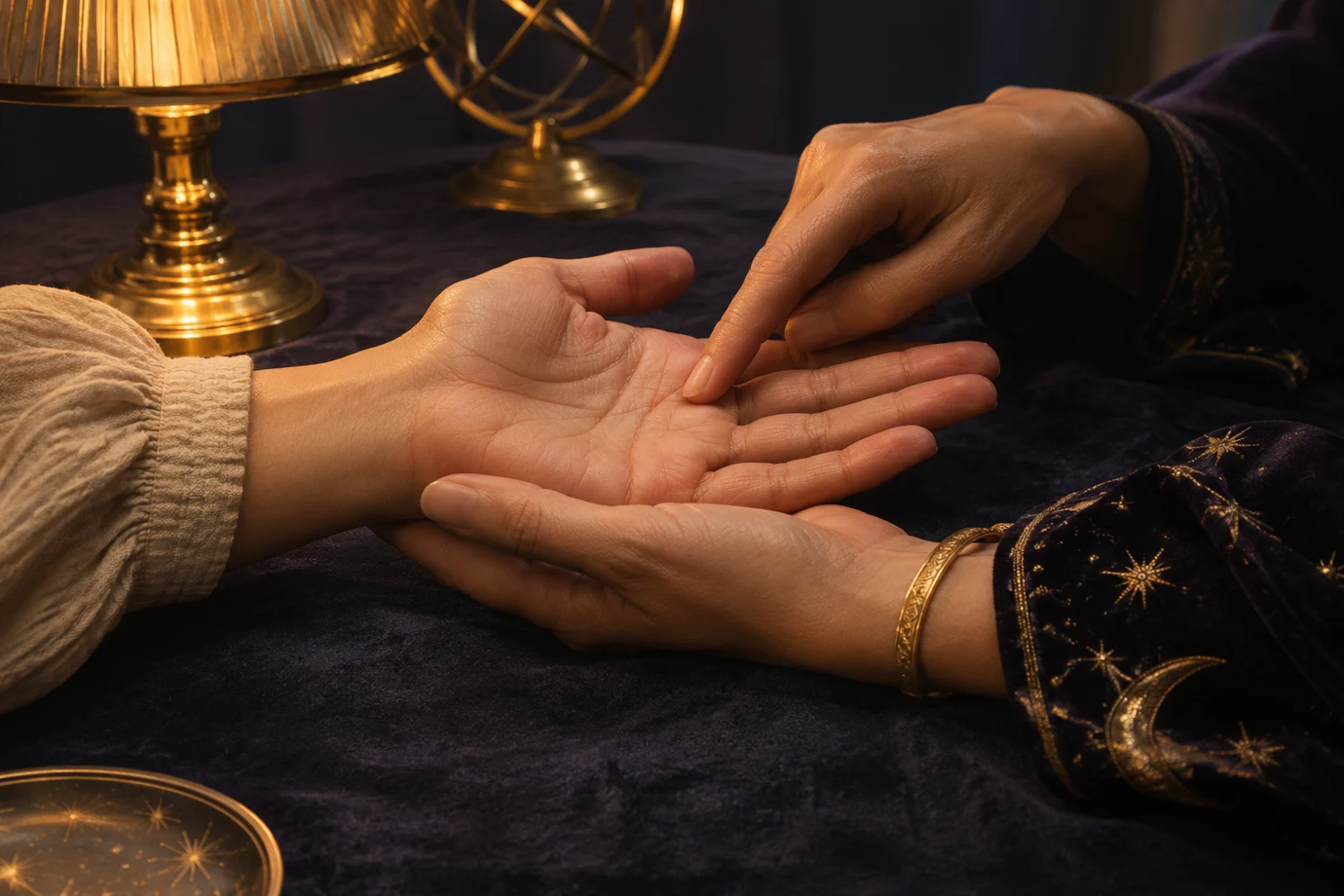
Vedic palmistry comes from India, where reading the hand is part of a wider tradition called Samudrika Shastra, the study of the body’s features. The branch devoted to the hand is sometimes called Hasta Samudrika Shastra.
A close companion to astrology
Vedic palmistry is often read alongside Jyotish, or Vedic astrology. Areas of the palm are linked with the planets, and some readers compare what they see in the hand with a person’s birth chart. This is one reason a reader may ask for your birthday.
What it looks at
- The lines, much as in other traditions.
- The mounts, each associated with a planet and its qualities.
- Special marks, such as small symbols or shapes in the palm, which the tradition treats as meaningful signs.
- Both hands, since some schools compare the two to see how a person has grown.
How to approach it
Like all palmistry, the Vedic tradition offers a symbolic way to look at character and life themes. Its meanings vary between teachers and texts.
Take what helps you reflect, and keep your own judgment. A reading is not a prediction, and it does not replace professional advice.